
Models / Chimera-1
Chimera-1
A method demo: two specialist skills merged into one 3B model, with no training at the merge step. On our checks both skills improved and no general benchmark moved outside run-to-run noise. Tetracta ran the evaluation; it has not been reviewed externally.
- Status
- Current
- Updated
- 8 Nov 2026
- Licence
- Qwen Research License, non-commercial
- Base model
- Qwen2.5-3B-Instruct
- Weights
- Public, bf16 safetensors
Model details
Chimera-1 asks one question: can two specialists be combined into a single model without training at the merge step, and without losing general ability? We made two light specialists from Qwen2.5-3B-Instruct, one for Roman-numeral conversion and one for character-level word operations. Then we merged them with TIES, a published merging method. The merge runs on a CPU in minutes, and the result is one 3B model with the same inference cost as its base.
Status of claims. The merge results on this page were measured by Tetracta, separately from Model X-Ray. They have not been reviewed externally. Any earlier claim that Model X-Ray guided, predicted or explained this merge is withdrawn. See the correction record.
| Item | Value |
|---|---|
| Developer | Tetracta |
| Released | Study published on 22 Jul 2026, with the weights on Hugging Face |
| Type | Causal language model made by a training-free weight merge (TIES) of two fine-tuned specialists |
| Base model | Qwen/Qwen2.5-3B-Instruct, in the Qwen2.5-3B family |
| Parameters | About 3B, the same as the base. Stored in bf16. |
| Chat format | Qwen2.5 ChatML, identical to the base |
| Languages checked | English, plus four other languages in the Belebele general check |
| Licence | Qwen Research License (licence name qwen-research), inherited from Qwen2.5-3B-Instruct: non-commercial, research use. Read the licence file linked from the Hugging Face card before any use. |
| Weights | Public on Hugging Face |
| Contact | [email protected] |
Intended use
Primary uses
- Research on model merging: what a training-free merge can and cannot carry into one model.
- Checking or extending our measurements.
- Trying the two implanted skills side by side with the base model.
Out of scope
- Commercial use of any kind. The licence does not allow it.
- Use as a production assistant. This is a method demo.
- Relying on its Roman-numeral or letter-operation answers without checking them.
- Merging with models that do not share its base. Weight merging needs a shared base.
Training data
- Base model: Qwen2.5-3B-Instruct, trained by its own developers on data they document. We did not change its pre-training.
- Specialists: light fine-tunes on synthetic, verifiable task data that can be generated without limit. One task is Roman-numeral conversion. The other is character-level word operations, such as spelling a word backwards. We checked each specialist on its task before merging. We do not publish the fine-tuning details.
- Merge step: uses no data.
- Evaluation sets: held-out skill items, MMLU, ARC-Challenge, HellaSwag, and Belebele in five languages.
Training procedure
| Step | What we did |
|---|---|
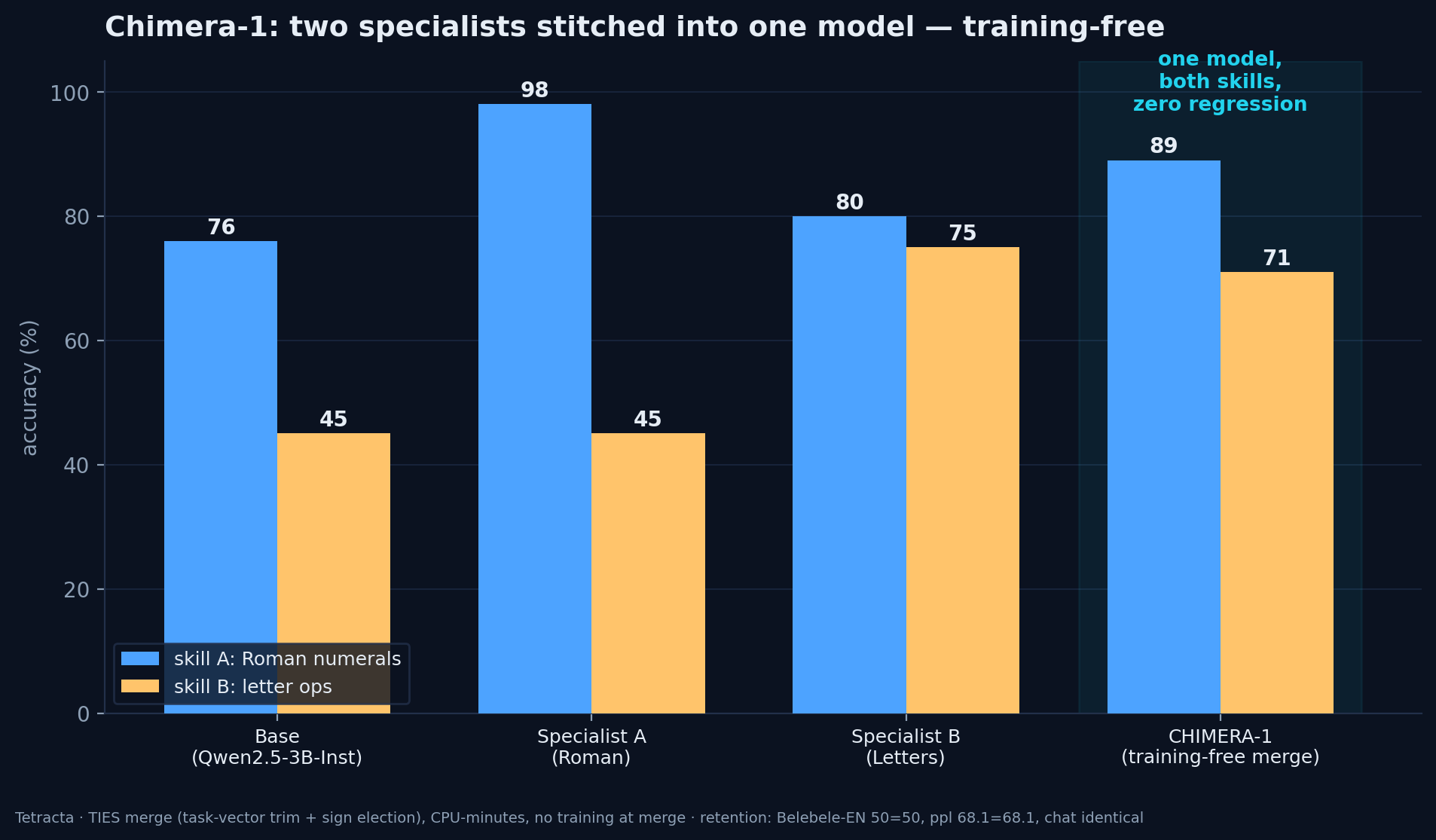
| 1. Specialists | Light fine-tuning of the top layers of Qwen2.5-3B-Instruct, once per skill. In the pilot, specialist A reached 98% on Roman numerals and specialist B 75% on letter operations. |
| 2. Merge | TIES on the two task vectors relative to the shared base: trim, sign election, disjoint mean. No training step. Runs on a CPU in minutes. |
| 3. After the merge | No further tuning. |
Evaluation
Pilot: 80 held-out items per skill
| Model | Roman numerals | Letter operations | Belebele-English | Fixed-text perplexity |
|---|---|---|---|---|
| Qwen2.5-3B-Instruct (base) | 76% | 45% | 50% | 68.1 |
| Specialist A | 98% | 45% | not measured | not measured |
| Specialist B | 80% | 75% | not measured | not measured |
| Chimera-1 | 89% | 71% | 50% | 68.1 |
Head-to-head against the base: 1,210 questions
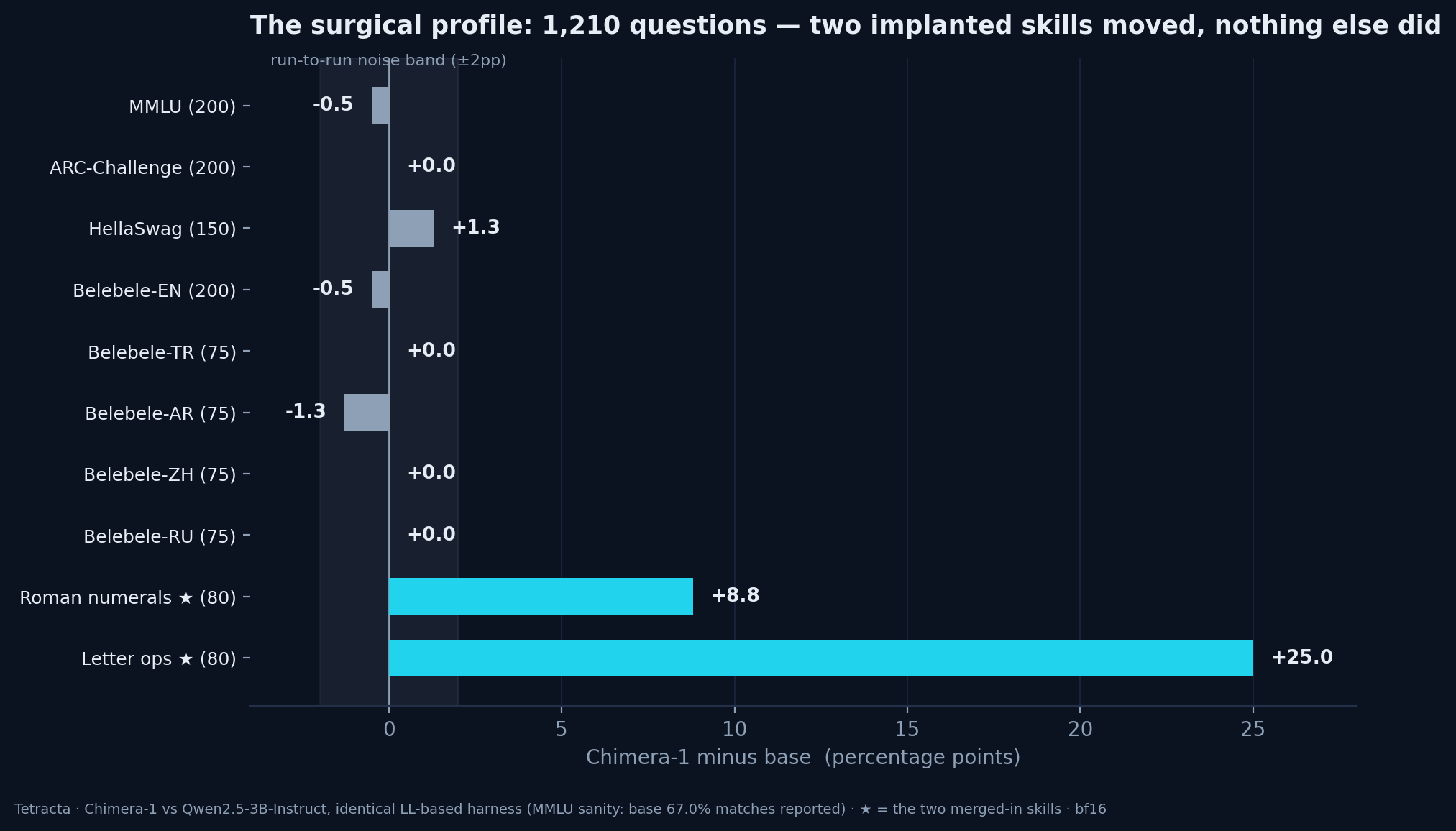
Both models ran on the same log-likelihood harness. As a sanity check, the base scores 67.0% on MMLU, consistent with its publicly reported value.
| Benchmark (items) | Base | Chimera-1 | Change, points |
|---|---|---|---|
| MMLU (200) | 67.0% | 66.5% | −0.5 |
| ARC-Challenge (200) | 81.5% | 81.5% | 0.0 |
| HellaSwag (150) | 70.0% | 71.3% | +1.3 |
| Belebele, English (200) | 51.0% | 50.5% | −0.5 |
| Belebele, Turkish (75) | 41.3% | 41.3% | 0.0 |
| Belebele, Arabic (75) | 50.7% | 49.3% | −1.3 |
| Belebele, Chinese (75) | 50.7% | 50.7% | 0.0 |
| Belebele, Russian (75) | 49.3% | 49.3% | 0.0 |
| Roman numerals (80) | 82.5% | 91.2% | +8.8 |
| Letter operations (80) | 37.5% | 62.5% | +25.0 |
The two target skills rose 8.8 and 25.0 points. All eight standard benchmarks stayed inside the ±2-point band, with a largest change of 1.3 points. This supports one bounded statement: on these 1,050 general questions we detected no regression larger than run-to-run noise. It does not show that nothing else changed.
The pilot and the head-to-head use different item sets and scoring, so their skill numbers differ, for example 89% and 91.2% on Roman numerals.
Controls and failures
The same campaign ran about 10 merge experiments at 0.5B and 3B, within one model family and across families. Some failed, and the failures are part of the result.
- No headroom: our first 3B attempt used tasks the base already solved (100% and 83%). The merge had nothing to add.
- No complementarity: merging a generalist with a coder that was no better at code diluted both, by 8 points on code and 11 on multilingual tasks.
- Too far from the base: aggressively merging a heavily continued-pretrained coder gave 0% on code and chance on everything else. This is our cleanest negative control.
- Three exploratory merge variants did not beat plain TIES on average.
Across these experiments, outcomes were associated with three conditions: headroom on the task, complementary parents, and parents still close to the shared base. We treat that as a working hypothesis for this campaign, not a validated rule.
Limitations and what is not done yet
- It is a method demo. The two skills are deliberately simple and verifiable, chosen because the base was weak at them.
- Tetracta evaluated it. No external review or reproduction has been done.
- Item counts are small: 75 to 200 per benchmark and 80 per skill. There are no confidence intervals, only the ±2-point noise band.
- One base model, one merge method and one pair of skills. The result may not hold for other bases or harder skills.
- Both skills still make errors after the merge: 91.2% and 62.5% in the head-to-head. Letter operations stayed below specialist B's 75% in the pilot.
- The three-condition pattern above comes from about 10 experiments. It is not a law.
Not done yet: an external review, confidence intervals, a safety evaluation of the merged model, and tests on harder or real-world skills.
Risks and safety
Chimera-1 inherits the behaviour, biases and safety tuning of Qwen2.5-3B-Instruct. We have not measured whether the merge changed its safety behaviour, and no safety evaluation of Chimera-1 is on record.
The licence allows non-commercial research use only. Do not use the weights in a product, a commercial demo or paid work.
The "no detected regression" statement covers the listed checks only. Do not read it as a guarantee about other tasks.
Environmental impact
All of the roughly 10 experiments in the campaign ran on two local consumer GPUs, with no cloud compute. The merge itself runs on a CPU in minutes. We did not record GPU-hours, and we have not measured energy use or emissions.
How to access
Weights and card are on Hugging Face: huggingface.co/tetracta/Chimera-1-Qwen2.5-3B. The model loads like its base. This snippet is from the Hugging Face card:
from transformers import AutoModelForCausalLM, AutoTokenizer
m = AutoModelForCausalLM.from_pretrained("tetracta/Chimera-1-Qwen2.5-3B", dtype="bfloat16")
t = AutoTokenizer.from_pretrained("tetracta/Chimera-1-Qwen2.5-3B")
# try: "Convert the Roman numeral CDXLIV to a regular number." / "Spell the word 'measure' backwards."
The full study, including the failed variants, is in our note Chimera-1: two skills, one model, training-free.
Citation
@misc{tetracta_chimera1_2026,
  title  = {Chimera-1: two skills, one model, training-free merge (method demo)},
  author = {Tetracta},
  year   = {2026},
  url    = {https://huggingface.co/tetracta/Chimera-1-Qwen2.5-3B}
}
The Hugging Face card has no BibTeX entry. This is the one we suggest.
Changelog
| Date | Change |
|---|---|
| 22 Jul 2026 | Study published, with the weights on Hugging Face. The 1,210-question head-to-head against the base was added as an update the same day. |
| 4 to 6 Sep 2026 | Model X-Ray interpretations of the merge withdrawn. The study page was revised, and a correction notice was added to the Hugging Face card on 6 Sep. |
| 8 Nov 2026 | This model card published on tetracta.ai. |
Merge or tune models for your task
We test merges and tuning against your own measurements.